01 / Platform & engineering strategy
AI doesn’t replace physics.
It lets us search the physics faster.
We are building gNu Design Intelligence: a computational engineering layer around a patent-pending supported-needle architecture. Real hardware defines the problem. Physical evidence defines progress.
Explore a technical partnership ↗gNu Design Intelligence / Under development
The physical foundation
The length has a job.
So does the support.
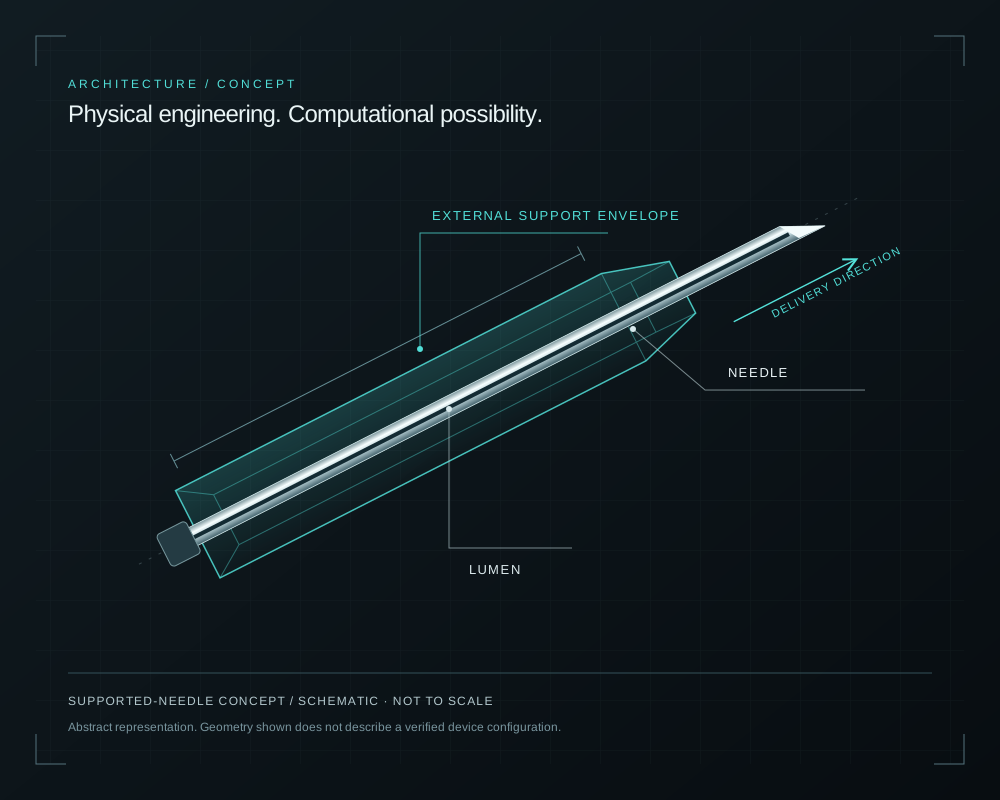
Intramuscular delivery requires reaching muscle. Simply making a needle shorter cannot remove the tissue depth it needs to traverse. The engineering question is how to support a slender needle while preserving the reach required by the intended application.
gNu’s patent-pending architecture considers the needle and its supporting structure as one system. That opens a design space spanning geometry, material selection, mechanical stability, insertion behavior, and fluid delivery.
Our purpose is to investigate those relationships together—and test whether a particular design meets a particular delivery requirement.
The system / From requirements to candidates
A design is only as useful
as the constraints it respects.
01 / Define the inputs
- Formulation
- Viscosity, volume, flow behavior
- Clinical delivery
- Target tissue, depth, use context
- Device
- Geometry, materials, available force
- Performance
- Insertion, flow, structural margin
- Development
- Manufacturing and validation criteria
02 / Connect the layers
Physics
Mechanics and fluid behavior constrain the search.
Data
Physical measurements anchor the model to reality.
Intelligence
Model-guided exploration prioritizes candidates to test.
03 / Return to hardware
Candidate designs.
Testable predictions.
Proposed geometries, explicit assumptions, and a physical validation plan.
↶ Every test informs the next searchProposed development workflow. A deployed AI optimization engine and validated model performance are future milestones.
The data loop
Capture the experiment.
Not just the result.
Our data strategy connects proprietary physical measurements to the geometry, material, test conditions, and observed failure modes that produced them. That context is what makes a result useful for the next engineering decision.
We plan to develop physics-informed models against that record, evaluate predictions on held-out observations, and use discrepancies to decide what to measure next. AI-guided optimization would then help prioritize candidates within a defined engineering domain.
The potential advantage is cumulative: a distinctive architecture, a relevant experimental record, and a disciplined learning process. Its value must be demonstrated through the quality of predictions and physical outcomes.
Development roadmap / Evidence before expansion
Six steps toward
a learning engineering platform.
- 01Measurement
Build the data foundation
Organize existing measurements and define repeatable experiments with traceable conditions.
- 02Representation
Develop the physical model
Connect relevant mechanics and flow behavior; calibrate and evaluate against experiments.
- 03Candidate search
Explore inverse design
Start with a delivery requirement and investigate candidate geometries within explicit constraints.
- 04Verification
Validate in physical hardware
Build and test proposed candidates. Document prediction error, failure modes, and operating limits.
- 05Iteration
Close the learning loop
Feed new observations into the next modeling cycle and measure whether candidate selection improves.
- 06Application
Develop partner programs
Evaluate defined applications with drug-delivery, device, and manufacturing collaborators.
The validation discipline
The bench gets
the final word.
A model can propose a promising design. A test program must establish what it actually does. Each application will need defined methods, acceptance criteria, and evidence appropriate to its intended use.
Penetration
Insertion behavior under defined conditions.
Drag
Resistance through the relevant test medium.
Structural margin
Stability and failure under expected loads.
At-depth delivery
Fluid delivery at the intended target depth.
Repeatability
Consistency across specimens and trials.
Manufacturability
Tolerances, materials, and production feasibility.
Build with gNu
Bring a delivery challenge.
Define the work together.
We are seeking partners with specific application requirements and collaborators in computational mechanics, physical testing, fluid modeling, and model-guided design.