Support changes
the equation.
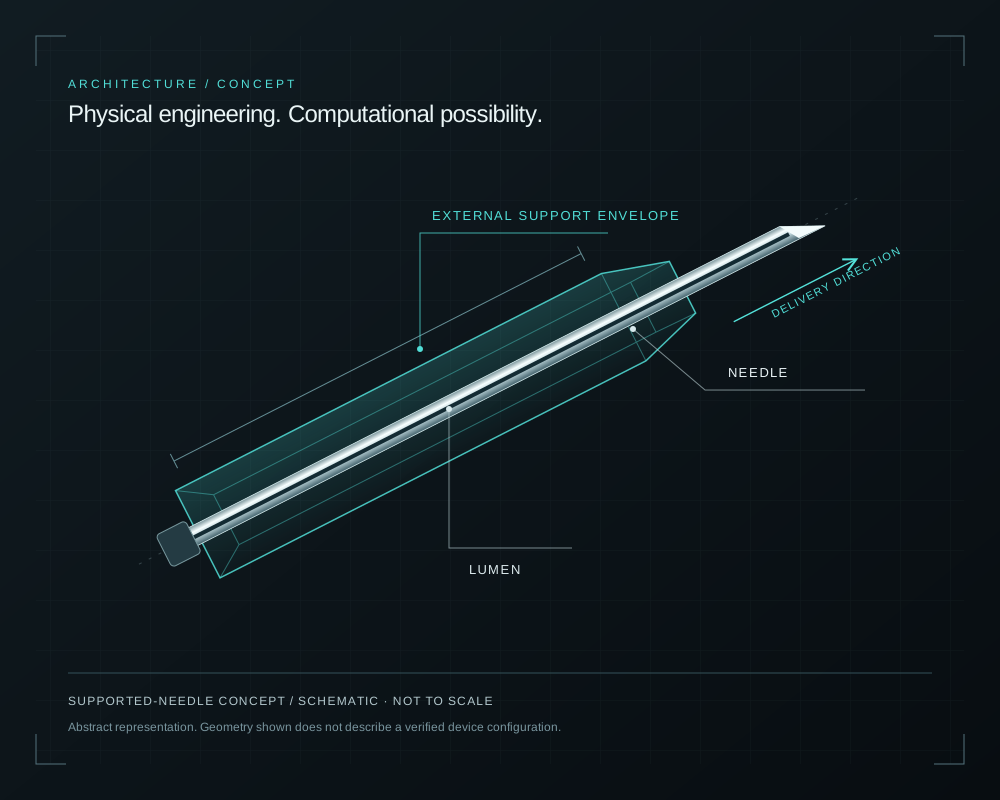
Investigate how the needle and its supporting structure work together across geometry, material, and loading conditions.
AI-NATIVE DRUG-DELIVERY ENGINEERING
Designing better injections with physics, data, and AI.
We are building a computational engineering platform around a patent-pending supported-needle architecture. Real hardware. Physical evidence. A new space to explore.
01 / THE PHYSICAL BREAKTHROUGH
A smaller needle.
A demanding delivery problem.
A different starting point.
Needle geometry has to reconcile competing demands: structural stability, flow, insertion depth, and the properties of the medicine itself. Changing one variable changes the problem.
gNu considers the needle together with the structure supporting it. This patent-pending architecture gives us a distinct physical system to investigate—and a richer set of engineering choices.
Our initial focus is intramuscular delivery, where reaching the intended tissue means length cannot simply be shortened. We want to explore how support, geometry, and fluid behavior can be engineered together.
The architecture grew from engineering insight, NSF-backed development, and physical prototype testing. Computation is the next chapter.
02 / THE PLATFORM WE ARE BUILDING
Our platform direction connects proprietary physical test data, physics-informed models, and AI-guided optimization in one learning loop.
Models propose where to look. Hardware tells us what holds up. The goal is a repeatable way to explore design choices and prioritize the next physical experiment.
Explore the development roadmap ↗Start with a delivery challenge. Set the constraints.
Explore mechanics, flow, and candidate geometry.
Turn a promising design into physical hardware.
Measure what happens under defined conditions.
Use physical evidence to refine the model.
03 / WHERE PHYSICS MEETS POSSIBILITY
Useful intelligence begins with a precise question. We are bringing the physical and computational pieces together around delivery challenges that matter.
Investigate how the needle and its supporting structure work together across geometry, material, and loading conditions.
Study delivery alongside formulation properties, flow requirements, and the mechanical constraints of the device.
Connect measurements to their conditions. Use disagreements between prediction and reality to inform the next iteration.
04 / BUILD THE NEXT CHAPTER
We are seeking investors, drug-delivery teams, and engineering partners to help turn a distinctive physical invention into a disciplined development platform.
Partner with gNu ↗