Keep the hardware central.
Start with the physical system and the engineering question it needs to answer.
02 / About gNu
The invention came from engineering insight. Our next chapter is to build the computational platform around it.
Our foundation
gNu began by reconsidering a familiar device: the needle. Instead of treating its geometry in isolation, we asked what could change when the needle and its supporting structure were engineered together.
That work led to a patent-pending supported-needle architecture, NSF-backed prototype development, and physical testing. The engineering invention predates this AI-native direction. It remains the physical foundation of everything we are building next.
Today, we are developing a strategy to connect that architecture and proprietary experimental data with physics-informed modeling and AI-guided optimization. The aim is to make design exploration more systematic, and each new experiment more informative.
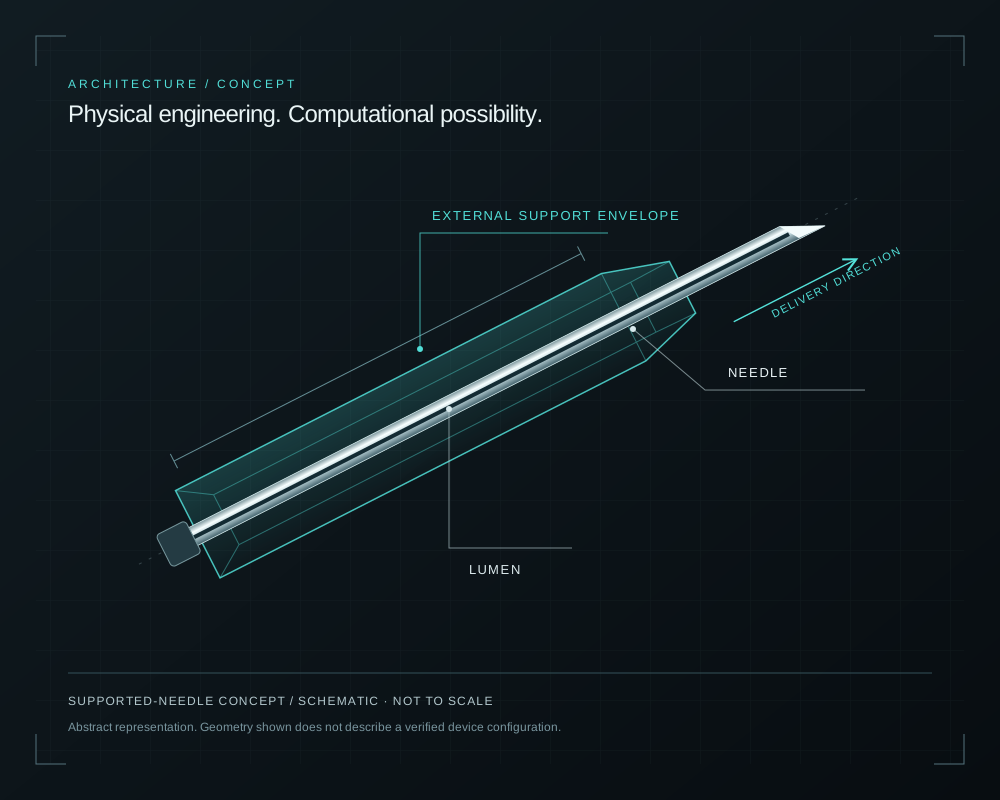
An architecture to investigate. A platform to build. / Conceptual engineering schematic.
Our point of view
AI should make our engineering more rigorous. Its value depends on what we can demonstrate in real hardware.
Explore the development strategy →Start with the physical system and the engineering question it needs to answer.
Connect every measurement to its conditions, assumptions, and limitations.
Be clear about what is established, what is being investigated, and what remains a development objective.
Define application work around real requirements and the expertise needed to evaluate them.
People / Direct connections
Business, IP & commercialization
Connect with David about the company, its intellectual property strategy, investment, and commercial partnerships.
david@gnucompany.com ↗Physical engineering
Connect with Steven about the supported-needle architecture, physical development, and technical collaboration.
steven@gnucompany.com ↗The next chapter
We are seeking computational engineering collaborators with expertise in mechanics, fluid modeling, experimental design, and AI-guided optimization—and investors who understand the work between a distinctive physical invention and a demonstrated application.
Calling gNu AI-native describes how we intend to build the next stage of the company. Our models, data workflows, and optimization capabilities are development objectives. Physical validation will remain the measure of progress.